

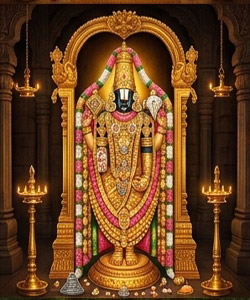
Perumal Temple
Palamalai Aranganathar Temple
### Sri Senkothai and Sri Poonkothai Samedha Sri Ranganathar Temple
The full name of the temple is **Sri Senkothai and Sri Poonkothai Samedha Sri Ranganathar Temple**. Situated at the foothill, the temple is approached through an impressive **east-facing welcome arch**, crowned by a colourful image of Sri Ranganathar in His *Sayana Kolam*. At the base of the arch are colourful images of Sri Garudalwar and Sri Anjaneya Swamy.
The temple itself is **east-facing** and features a magnificent **three-tiered Rajagopuram**. In front of the Rajagopuram is a four-pillared Mandapam containing a Deepasthambam. The base of the Deepasthambam bears an east-facing image of Sri Anjaneya Swamy and a west-facing image of Sri Garudalwar. Two black elephant idols stand on either side of the entrance to the temple premises. Beyond the Rajagopuram is a vast, tiled, multi-pillared Mandapam, with each pillar adorned with an image of a *Yaali*.
Inside the temple are a **gold-plated Neivedhya Peedam (Bali Peedam)** and a **gold-plated Dwajasthambam (Kodi Maram)**. A four-pillared sub-shrine houses Sri Garudalwar, who faces the Moolasthanam. Above this area is a colourful Gopuram depicting Sri Ranganathar in His *Sayana Kolam*. The spacious Mandapam beyond the Gopuram is used for conducting various religious and festive functions.
To the left is an east-facing sub-shrine dedicated to **Sri Lakshmi Hayagreevar**, while on the right is a north-facing shrine for **Sri Anjaneyar**.
### Sri Ranganathar – Presiding Deity
The presiding deity of the temple is **Sri Ranganathar**, revered as a **Swayambhumoorthy**. He is east-facing and stands within the Sanctum Sanctorum. Though diminutive in appearance, the deity is believed to possess immense divine power and is regarded as a compassionate bestower of boons upon His devotees. Behind the diminutive Swayambhumoorthy is another east-facing standing image of Sri Ranganathar.
The entrance to the Sanctum Sanctorum is particularly striking, with a dazzling **gold-plated threshold**. The divine guardians **Jayan and Vijayan** stand at the entrance to the Moolasthanam. The temple is distinguished by several gold-plated thresholds, each embellished with etched images of **Sri Chakkrathalwar, Sri Yoga Narasimhar and Sri Krishna**.
Flanking the Moolasthanam are the east-facing shrines of the two divine consorts of Sri Ranganathar: **Sri Senkothai Thaayar** on the left and **Sri Poonkothai Thaayar** on the right. Both are depicted in seated postures. The outer walls of the Thaayar Sannadhis are adorned with colourful images of **Sri Manavala Maamunigal** and Sri Ranganathar seated upon Garudalwar with His consorts, **Sri Devi and Bhoo Devi**.
### Other Shrines and Divine Images
Around the temple are numerous shrines and sacred images reflecting the rich Vaishnavite tradition. An east-facing shrine houses **Sri Chakkrathalwar**, with a west-facing image of **Sri Yoga Narasimhar** situated behind Him.
The temple also houses images of the twelve Alwars, facing north:
* Sri Poigai Alwar
* Sri Boothathalwar
* Sri Peialwar
* Sri Thirumazhisai Alwar
* Sri Nammalwar
* Sri Madurakavi Alwar
* Sri Kulasekara Alwar
* Sri Periyalwar
* Sri Andal Nachiyar
* Sri Thondaradipodi Alwar
* Sri Thiruppaan Alwar
* Sri Thirumangai Alwar
**Sri Para Vasudeva Perumal** is placed among the Alwar images and is also north-facing. An east-facing sub-shrine is dedicated to **Sri Viswaksenar**.
The east-facing shrine of **Sri Thumbikkai Alwar** is guarded by two Naaga Devatha idols. Nearby is a multi-pillared Mandapam containing the east-facing shrine of **Sri Arul Kalidasa Swamigal, also known as Sri Kaaliannan Swamigal**. It is believed that He attained **Jeeva Samadhi on 1 January 1939**. An image of the Swamigal has been installed at the shrine, with a Nandhi Vaahanam placed facing it.
Another east-facing shrine houses **Sri Koorathalwar, Sri Ramanujar and Sri Muthalaiandan** together. Near the north-facing shrine of Sri Anjaneyar is the east-facing shrine of **Sri Dhanwanthri Perumal**, revered as the Supreme Physician and worshipped by devotees seeking relief from ailments.
### Sorga Vaasal and Dasavathara Shrine
The temple's **Vaahana Mandapam** is maintained with great care and cleanliness. A **South-facing Sorga Vaasal, or Paramapatha Vaasal**, is also present within the temple complex. Close to it is a south-facing shrine containing the images of the **Dasavathara**, the ten incarnations of Lord Vishnu:
1. Sri Matsya Avatharam
2. Sri Koorma Avatharam
3. Sri Varaha Avatharam
4. Sri Narasimha Avatharam
5. Sri Vamana Avatharam
6. Sri Parasurama Avatharam
7. Sri Rama Avatharam
8. Sri Balarama Avatharam
9. Sri Krishna Avatharam
10. Sri Kalki Avatharam
A south-facing **Yaaga Saalai** is also found within the temple premises. It is noteworthy that the Bhattachariars serving the temple are provided with rooms for their official use.
### Temple Facilities and Sacred Traditions
The temple has a **Madapalli**, where Prasadam is prepared and distributed to devotees, as well as an **Annadhana Koodam** providing food to devotees.
The **Sthala Viruksham** of the temple is the **Kaarai Tree**. Its sacred water bodies, known as *Theerthams*, include **Palamalai Theertham, Padma Theertham, Pasumai Theertham, Kannimar Sunai and Senkothai Sunai**.
A particularly cherished local belief is associated with the **Poovarasam Tree**. Devotees tie threads around the tree with prayers for the blessing of children and a harmonious married life.
### Festivals
The temple celebrates its annual **Chithirai Car Festival**, which is conducted grandly over ten days. Special Poojas are also performed on **Krishna Jayanthi, Hanumanth Jayanthi, Deepavali and Pongal**, drawing devotees to the temple throughout the year.
With its Swayambhumoorthy Sri Ranganathar, sacred shrines, numerous Vaishnavite icons, gold-plated architectural features, revered Jeeva Samadhi and traditional festivals, the temple stands as a spiritually significant centre of worship and devotion.