

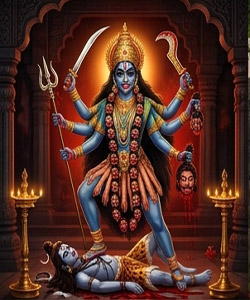
Bhadrakali Temple
Major Vellayani Devi Temple
Major Vellayani Devi Temple is a prominent Bhadrakali shrine beside Vellayani Lake in Thiruvananthapuram district, Kerala. The Goddess is worshipped as a powerful and protective form of the Divine Mother, and the temple is known across the region for the scale and duration of its Kaliyoottu Mahotsavam. Unlike a pilgrimage fair centred on travel to a distant site, Kaliyoottu is a long ritual observance rooted in the temple and its surrounding community. The shrine remains active outside the festival period, with regular worship and offerings to Vellayani Amma.
Kaliyoottu is held once every three years and is widely described as one of South India’s longest temple festivals, lasting roughly 65 to 70 days. The ritual is a dramatic enactment of the origin and victory of Bhadrakali over the demon Darika. Through sung narrative, ritual movement and processional observances, the festival presents the triumph of divine order over destructive forces. The final Nilathilporu ceremony marks the climactic confrontation. This is not simply a spectacle: the performance is part of the temple’s religious practice and should be understood within the devotional framework of the Goddess’s protection.
The celebration brings together different ritual specialists, local communities and devotees from across the district. Pongala and other observances connected with the festival attract large participation, while the temple’s calendar also includes regular Devi worship and seasonal rites. Because the festival cycle spans many weeks and is tied to the Malayalam calendar, exact dates vary; visitors should check the current temple announcement rather than relying on a previous year’s schedule. The temple’s own guidance is also important for understanding the sequence of ceremonies and appropriate access.
The setting near Vellayani Lake contributes to the experience, placing the shrine in a landscape of water, settlements and agricultural life on the southern edge of the capital region. Visitors can approach the temple as part of a broader local visit, but worship and festival arrangements take priority. During Kaliyoottu, the surrounding area becomes exceptionally busy and movement may be regulated. Modest dress, respect for ritual boundaries and attention to temple instructions are essential. The temple’s importance lies in its active Bhadrakali worship, the unusual three-year festival cycle and the survival of a community ritual drama that makes sacred narrative visible to devotees.
The temple’s own setting and calendar are essential to understanding Kaliyoottu. A visitor may see music, dramatic performance and processions, but these are embedded in worship and are not staged independently for an audience. Devotees follow the full sequence as a religious observance, while temple authorities coordinate access and ritual boundaries. Outside the triennial festival, the shrine continues its ordinary puja cycle and attracts local worshippers. The lake, the temple and the community together form the setting for the Goddess’s annual and long-cycle observances.