

Hanuman Temple
Arulmigu Anumantharaaya Swamy Jaya Mangala Anjaneyar Temple
### Hanuman of Idugampalayam
The suffix *pallayam* is traditionally associated with places where army camps were established. When the Palayakars set up an army camp near Sirumugai, the settlement of Idugam came to be known as **Idugampalayam**. Located just about five kilometres from Sirumugai, this quiet village is home to the revered **Sri Jayamangala Anjaneya Temple**, a shrine steeped in history and devotion.
### The Ancient Hanuman Shrine
Long before the Palayakars established their military camp, the village is believed to have been home to a shrine dedicated to Sri Hanuman. The deity is said to have been worshipped by soldiers associated with the Vijayanagara Empire, the Madurai Nayaks, and the Mysore Maharajas. It is therefore possible that the original shrine was established or patronised during the rule of one of these dynasties.
For generations, knowledge of the Hanuman shrine remained largely confined to the local villagers. The inscriptions found at the temple, together with the presence of a *fish* emblem and the royal insignia associated with the Pandya dynasty in the Sannidhi of Shiva and Parvati, suggest that the site may once have formed part of a larger temple complex. Over the centuries, the shrine may have suffered destruction and neglect, with many of its original treasures lost. Yet the image of Sri Hanuman survived, continuing to inspire the faith of the local people.
### The Temple of Hanuman
Until the early 1990s, Sri Hanuman stood beneath the open sky, with villagers offering their prayers and simple offerings with deep devotion. In the 1990s, the people of the village came together to construct a modest shrine for their beloved deity, reverently known as **Sri Hanumantha Rayan Koil**, a traditional name used in this region.
As stories of the deity's grace and the fulfilment of devotees' prayers spread, the number of pilgrims gradually increased. What began as a humble village shrine has since grown into a substantial temple complex, rebuilt and expanded through the devotion and contributions of its devotees.
The present temple consists of a *Garbhagriha* measuring approximately 16 × 16 feet, followed by an *Artha Mandapa* and a spacious *Maha Mandapa*.
### The Magnificent Sri Hanuman
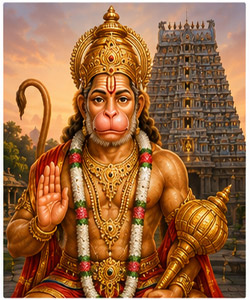
The principal image of Sri Hanuman is an impressive figure, approximately six and a half feet high and five feet wide. Unlike Hanuman images in certain other sacred centres, the deity here is *Yadurmukhi*—His face is fully visible to the devotee, allowing an unobstructed *darshan*.
His right hand is raised in the gesture of *Abhaya Mudra*, assuring devotees of protection and blessing. A small *Chakra* can be seen in the palm of this hand. In His left hand, the Lord holds a *Sowgandhika* flower, depicted before it has fully blossomed, rising above His left shoulder.
His broad chest is adorned with traditional ornaments, while His tail emerges behind His right arm, curves upward above His head, and ends in a gentle bend. A tiny bell adorns the tip of His tail, adding a distinctive detail to the divine image.
Most captivating, however, are His eyes. They appear radiant and intensely alive, gazing directly at the devotee. The directness of His gaze creates a powerful sense of presence, making the *darshan* both mesmerizing and deeply moving.
For devotees who visit Idugampalayam, Sri Jayamangala Anjaneya is not merely an ancient image preserved through the centuries, but a living embodiment of faith, protection, and divine grace.