

Rama Temple
Thiruvangad Sree Rama Swami Temple
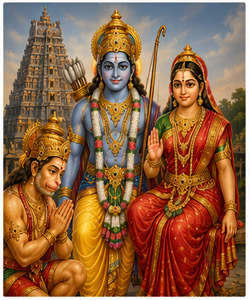
Thiruvangad Sree Rama Swami Temple is a prominent Rama shrine in Thalassery, Kannur district, Kerala. Dedicated to Rama, an incarnation of Vishnu, it is one of the major Rama temples of the state and a landmark in North Malabar’s religious and architectural history. The temple is popularly known as the Brass Pagoda because its roofs are sheathed in brass rather than the customary clay tiles. This distinctive roof treatment gives the complex a recognizable appearance and reflects the region’s rich tradition of wood and metal craftsmanship.
Kerala Tourism identifies the shrine as one of the five important temples dedicated to Rama in Kerala. The temple’s own Devaswom history also places it within the political history of Thalassery: it served as a meeting place for the rulers of Kolathiri, Kottayam and Kadathanadu, where agreements with the British East India Company were made. These accounts show the shrine’s dual role as a religious centre and a significant public place. The temple’s cultural importance is therefore connected not only to Rama worship but also to the history of local rulers and the colonial-era coastal town.
The temple follows Kerala architectural conventions, with a sacred precinct organized around the sanctum and structures for ritual movement. Brass-covered roofing is its most visible feature, but the broader complex includes sculptural and painted elements that belong to the region’s distinctive temple art. The building’s scale and ornamentation make it an important part of the Thalassery heritage circuit, which includes the fort, old commercial streets and other religious landmarks. Visitors can appreciate the temple’s craftsmanship while recognizing that it remains an active place of worship.
Daily puja and offerings centre on the image of Rama, while festivals and special observances bring devotees together through the year. The exact ritual schedule follows the temple calendar and should be confirmed locally. As with other active Kerala temples, respectful dress and quiet conduct are expected, and access to inner areas or photography may be restricted. The temple should not be treated simply as a historic building: local worship continues and shapes how the precinct is used.
Thiruvangad Sree Rama Swami Temple is significant as a major Rama shrine, an architectural landmark known for its brass roof, and a site connected with the political history of Thalassery. The combination of devotional practice, regional craftsmanship and local history gives the temple a distinctive place in Kannur district. A visit offers a way to understand North Malabar’s sacred architecture and the long relationship between temples and community life in the region.