

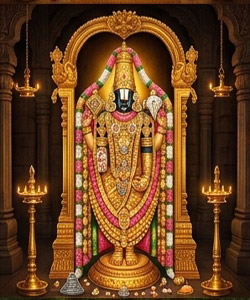
Venkateswara Temple
Sri Narapura Venkateswara Swamy Temple
The Sri Narapura Venkateswara Swamy Temple stands at Jammalamadugu in Andhra Pradesh’s present-day YSR Kadapa district, beside the Penna River. It is dedicated to Lord Venkateswara, a form of Vishnu worshipped widely across the region. The shrine’s local name preserves the memory of Narapuraiah, the devotee associated with its origin story. The Tirumala Tirupati Devasthanams (TTD) account places the temple within a landscape once known for a large water tank and thick Jambu trees. The tank was called Jambulamadugu, a name connected in the account with the later place-name Jammalamadugu. The river, tank and town are therefore woven together in the sacred geography remembered by the temple community.
According to the temple’s sthalapuranam, Narapuraiah received a divine instruction in a dream. Lord Venkateswara told him that an image of the deity could be found near Jambulamadugu, on the banks of the Penna. Narapuraiah went to the indicated place, found the idol and installed it on a sand mound north of the town. The temple’s name, Sri Narapura Venkateswara, is linked to this devotee and his role in establishing worship at the site. This is a religious foundation story preserved by the temple authority; it should be understood as local sacred tradition rather than treated as a dated historical record.
The TTD account also refers to inscriptions on stones at the present temple. It says the shrine established by Narapuraiah later became dilapidated and was renovated in 1919 with the cooperation of local devotees. This detail gives the temple story two connected parts: a devotional origin centred on the discovery and installation of the image, and a later community effort to restore the place of worship. The renovation indicates that the shrine’s continuity has depended on local participation as well as the institution that administers it today. The temple came under TTD control on 23 October 2008. TTD states that, following the transfer, the worship services have been conducted according to Pancharatra Agama.
The annual Brahmotsavams are held in the month of Vaisakha. TTD describes them as a regular yearly celebration honouring Lord Venkateswara. Brahmotsavam is a major temple festival tradition in which the deity is ceremonially worshipped and taken through festival observances; the specific schedule and arrangements can vary by year. TTD’s recent announcements of the Jammalamadugu festival show that the celebration remains part of the temple’s active calendar. Devotees planning to attend should check current dates, seva details and access arrangements with TTD or the temple, since a lunar-month festival does not fall on the same Gregorian dates every year.
For a visitor, the temple is best approached as a living regional shrine rather than simply as a monument. Its significance is carried by the worship of Venkateswara, the memory of Narapuraiah, the Penna riverbank setting and the annual festival. The story connects a devotee’s dream with a landscape of water and trees, while the 1919 renovation recalls the role of local people in maintaining the sanctuary. TTD’s administration and Agama-based services form the present institutional setting for worship. Visitors should follow the instructions of temple staff and the customs observed in the shrine. The official information does not provide a dependable current timetable or a full visitor guide in the temple history page, so opening hours and particular services should be confirmed before travel. Together, these traditions make Sri Narapura Venkateswara Swamy Temple an important place of devotion in Jammalamadugu and a distinctive part of the Venkateswara pilgrimage landscape of the Penna valley.