

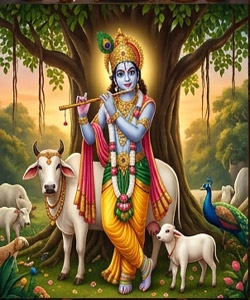
Lord Krishna (Ananta Vasudeva) Temple
Sri Ananta Vasudeva Temple
Sri Ananta Vasudeva Temple is a major Vaishnava shrine in the old town of Bhubaneswar, situated on the eastern side of the Bindusagar tank. Most of Bhubaneswar’s historic temples are dedicated to Shiva, so Ananta Vasudeva has a distinctive place within the city’s sacred landscape. The temple is dedicated to Vishnu in his form as Vasudeva, and its sanctum houses a triad of images associated with Krishna, Balarama and Subhadra. The shrine is an active centre of worship and also a key monument for understanding the variety of religious traditions present in the Ekamra Kshetra.
The temple was built in the thirteenth century under the Eastern Ganga dynasty. Historical accounts associate its construction with Queen Chandrika, wife of King Anangabhima III, who is said to have commissioned the shrine. The architectural plan resembles the established Odishan temple form, with a sanctuary, assembly hall, dancing hall and offering hall arranged along an axis. Yet its sculptural and ritual program is Vaishnava rather than Shaiva. Images and motifs related to Vishnu appear throughout the complex, and the temple’s kitchen is particularly important in local religious life. Mahaprasad prepared for the deity is offered and then distributed to devotees, linking the temple to a wider Odishan custom in which sanctified food is shared as part of worship.
The location beside Bindusagar connects Ananta Vasudeva with one of Bhubaneswar’s central sacred tanks and places it close to other historic shrines. The city’s old town is best understood as a network of temples, tanks and ritual routes, not as a collection of isolated monuments. Ananta Vasudeva contributes a strong Vaishnava presence to this network and shows how the Eastern Ganga rulers supported different forms of Hindu worship. Its relation to the broader Jagannath tradition is also meaningful, since the triad of deities resonates with the familiar forms of Balarama, Jagannath and Subhadra, though local iconographic details and ritual practice belong specifically to this temple.
Daily worship, offerings and festivals continue to structure the site. Visitors can observe the exterior architecture and the life around the temple, while access to inner spaces and ritual areas follows local rules. Respectful behaviour is essential, especially during puja and food distribution. Ananta Vasudeva is significant as a thirteenth-century royal foundation, a rare major Vaishnava temple in a predominantly Shaiva city, and a living centre where darshan, ritual food and community practice remain central. Its setting beside Bindusagar makes it a natural part of an old-town heritage visit, but its importance is ultimately devotional: the temple continues to serve worshippers as well as students of Odisha’s architecture and history.