

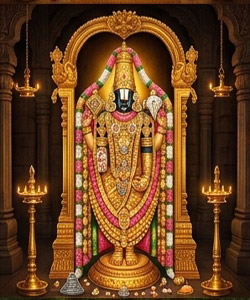
Venkateshwara Temple
Cochin Thirumala Devaswom Temple
Cochin Thirumala Devaswom Temple, also known as Gosripuram, is an important Venkateswara shrine in Mattancherry, Kochi. It belongs to the Gowda Saraswath Brahmin community and functions as both a temple and a major socio-religious institution. The presiding deity is Venkatachalapathy, worshipped as Gosripurusha Thirumala Devar. The temple’s history reflects the migration of Konkani-speaking GSB families from Goa to Kochi and the long relationship between this community, the port city and the shrine.
Kerala Tourism traces the community’s arrival to the sixteenth century, in the aftermath of the fall of Vijayanagara and Portuguese pressure in Goa. Swami Vijayendra Teertha is associated with bringing the Venkatachalapathy image to Kochi. A temple was established in 1599, but the shrine’s history includes repeated upheaval. The Portuguese destroyed the temple in 1662; it was reconstructed under Dutch rule. In 1791, the image was taken away during conflict and remained in Alappuzha for a period before being returned to Kochi in 1853. The temple’s own history recounts three consecrations, in 1599, 1719 and 1881, reflecting rebuilding and the continuity of worship through changing political circumstances. These events make the shrine an unusually clear example of how religious images and institutions can anchor a migrant community across generations.
The complex includes shrines to Hanuman, Garuda, Ganapati and Mahalakshmi in addition to the main Venkatachalapathy shrine. A large bronze bell in the courtyard is one of the temple’s notable features, and a temple tank forms part of the compound. The architectural environment is closely tied to Mattancherry’s older neighbourhoods, where temples, markets and community institutions stand within a dense urban fabric. The temple remains active, with regular puja and annual festivals, including observances in November and April. Its six-day Aarattu festival is traditionally linked to the consecration calendar.
Cochin Thirumala Devaswom is significant as a centre of Venkateswara worship and as the institutional heart of a community with deep roots in Kochi. Its history preserves memories of migration, colonial conflict, return and reconstruction. Visitors interested in the temple should respect its community customs and local rules for entry and photography. The shrine is not merely an architectural landmark in Mattancherry; it continues to serve worshippers and supports a living heritage that includes Konkani language, ritual and community life. It offers a distinctive perspective on how Kochi’s history has been shaped by migration and religious institutions as well as by maritime trade. The annual ceremonies also connect families dispersed across Kerala with their community’s historic centre.